The right outdoor kitchen lighting ideas do two things at once: they make cooking safer after dark, and they turn your backyard into a place people want to stay long after the food is gone.
Most people get this wrong. They pick one overhead light and call it done. The space ends up looking flat, the food looks bad, and the whole area feels empty at night.
This guide covers every lighting type worth using, how to layer them the right way, what specs actually matter, and how to plan your layout zone by zone. Whether you are starting from scratch or improving an existing setup, this is the complete reference.
Most homeowners spend a lot of time choosing the right grill, countertops, and appliances. Then they add a single overhead light and consider it done.
The result is a kitchen that looks bright and flat, makes food look dull, and feels empty as an entertainment space the moment the sun goes down.
Good outdoor kitchen lighting extends how many months and hours per year you actually use the space.
It makes food prep safer (no guessing at grill temperatures in the dark), makes your guests more comfortable, and adds real visual appeal that makes the whole setup look more valuable.
The difference between a backyard people linger in and one they leave after dinner almost always comes down to how the space is lit.
The best time to think about outdoor kitchen lighting is during the design phase, before any structure goes up. Hardwired fixtures under a pergola or in a covered kitchen require conduit runs that are much easier to route before walls and ceilings are finished. If you are using BetterPatio's free 3D design service, mention your lighting plan so the team can confirm clearances and fixture placement in the rendering.

Before you look at specific fixtures, it helps to understand the three layers that every well-lit outdoor kitchen needs. Think of them like the foundation, walls, and finishing touches of a house.
Each layer has a distinct job, and all three work together to create something that feels right.
Task lighting is bright, focused light aimed directly at work surfaces. In an outdoor kitchen, that means your grill, countertops, cutting board areas, and sink.
The goal is shadow-free visibility in places where sharp tools, hot surfaces, and raw food are all in play at the same time.
Under-cabinet LED strips and recessed downlights above the counter are the two most effective task lighting options.
You need enough brightness to see grill grates clearly and check doneness without leaning in or squinting.
Ambient lighting provides the general light for the whole outdoor kitchen and dining area. It fills in the shadows that task lighting creates and sets the overall brightness of the space.
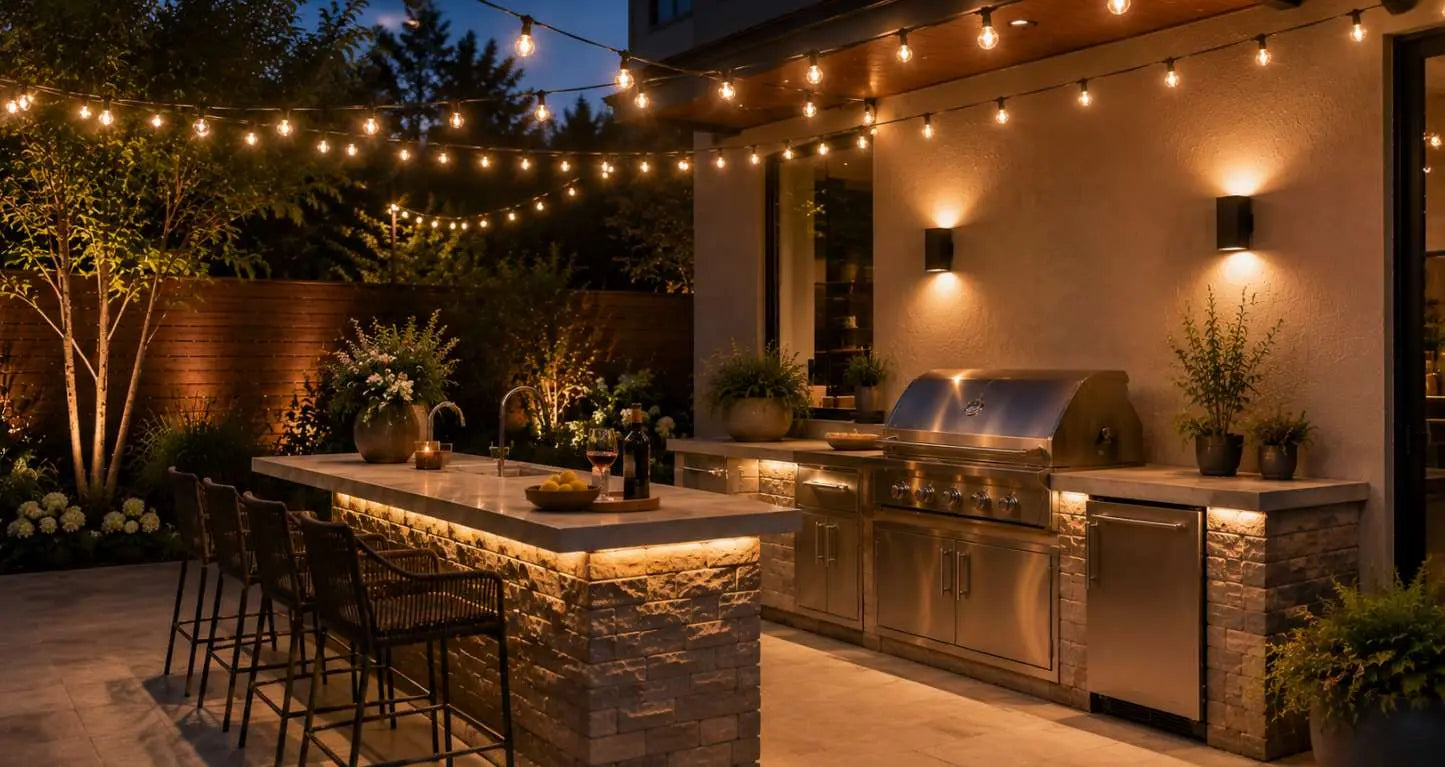
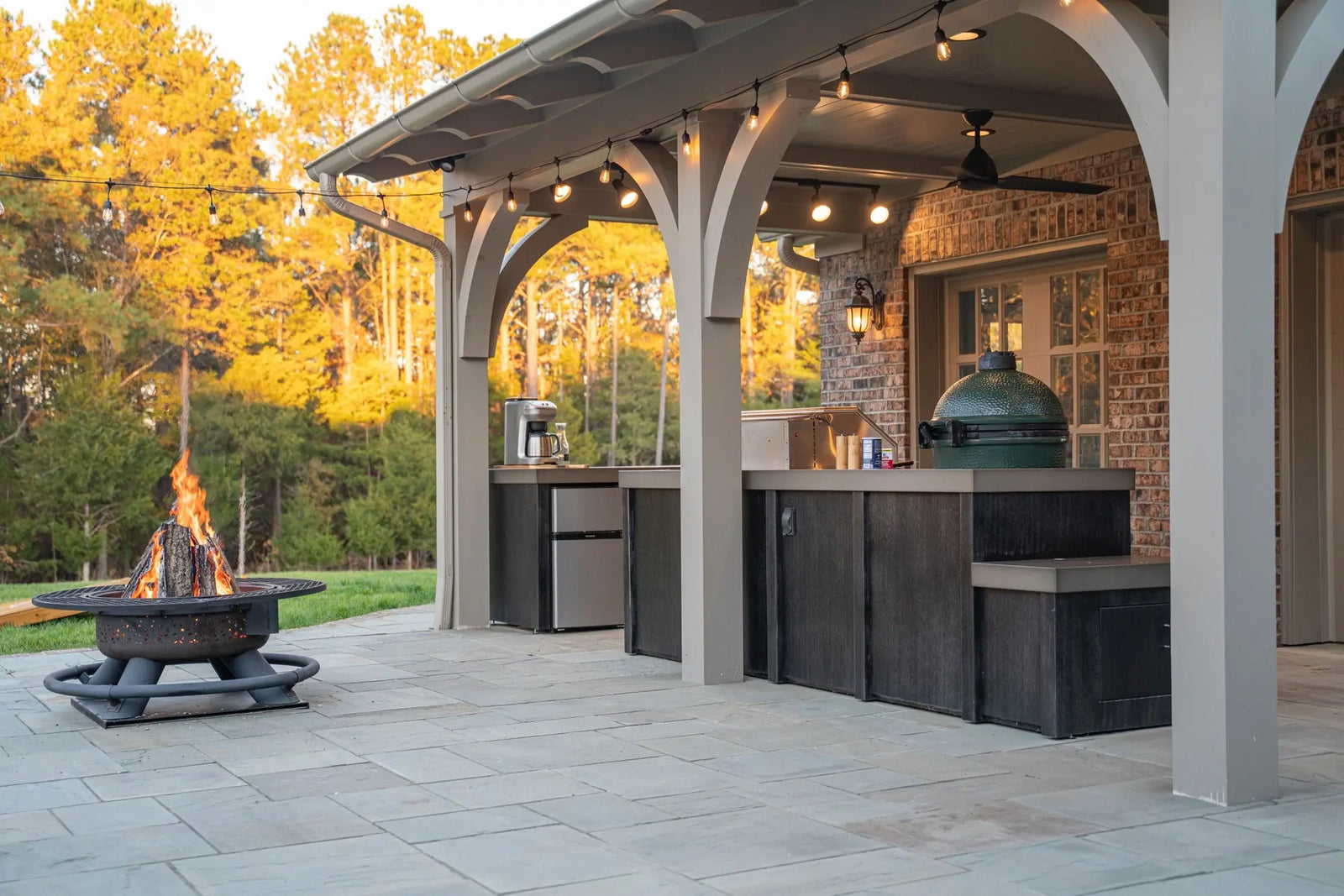
String lights, pendant lights over a bar or dining counter, ceiling fans with built-in lights, and recessed lights in a pergola ceiling are all good ambient sources.
Warm-toned ambient light in the 2700K to 3000K range creates the relaxed, welcoming atmosphere that makes people want to stay at the table.
Accent lighting highlights specific features rather than lighting the whole area.
This includes uplights on plants and trees, a spotlight on a stone backsplash, LED strip lighting along the base of the kitchen island, path lights leading to the kitchen, and small fixtures that draw attention to architectural details.
Accent lighting is what separates an outdoor kitchen that looks professionally designed from one that just looks functional.
It adds depth and makes the whole space feel finished.

This is the most practical upgrade you can make to any outdoor kitchen. LED strips mounted under overhead cabinets or along the front edge of a pergola beam shine light directly onto the counter below.
No shadows, no glare, and completely focused on the work surface. Use waterproof IP65-rated strips designed for outdoor use.
Set the color temperature to 3000K to 4000K for the clearest visibility while cooking.

String lights are the fastest and most affordable way to add warm ambient light to an outdoor kitchen area.
Run them across a pergola, along a fence, or overhead between two anchor points.
Globe-style Edison bulbs at 2700K give the most flattering, warm tone.
Always choose outdoor-rated waterproof versions and make sure the total wattage stays within your circuit rating.

If your outdoor kitchen has a covered structure overhead, recessed lights give you clean, even ambient and task lighting with zero visual clutter.
Space them about 4 feet apart for consistent coverage. Use wet-rated recessed trims (not just damp-rated) for any fixture that could be hit by direct rain.
This gives the cleanest, most built-in look of all the fixture options on this list.

If your outdoor kitchen has a bar counter or eat-at seating, pendant lights hung 30 to 36 inches above the counter surface give you both task illumination and a strong visual anchor for the zone.
Always choose fixtures with an outdoor or damp-rated certification.
Two or three smaller pendants usually look better than one large fixture over a long counter run.

Accent uplights placed at the base of nearby trees, large shrubs, or pergola posts create depth and extend the lit area well beyond the kitchen itself.
This makes the whole outdoor space feel larger and more planned.
In-ground uplights with IP67 ratings are the most durable choice and stay completely invisible during the day.

Any path leading to your outdoor kitchen, and any step or change in ground level, needs lighting for safety.
Low-profile path lights placed 6 to 8 feet apart give enough guidance without overwhelming the overall lighting plan.
Recessed step lights built into stair risers are the cleanest and most durable option for any permanent installation.

Wall-mounted sconces on the exterior wall of the house or on pergola posts provide ambient light at eye level.
Eye-level light is more flattering and welcoming than overhead light alone, and it fills in the mid-zone that most outdoor lighting plans miss.
Black-finish lanterns are the most popular choice because they work well with modern, traditional, and transitional outdoor kitchen styles.

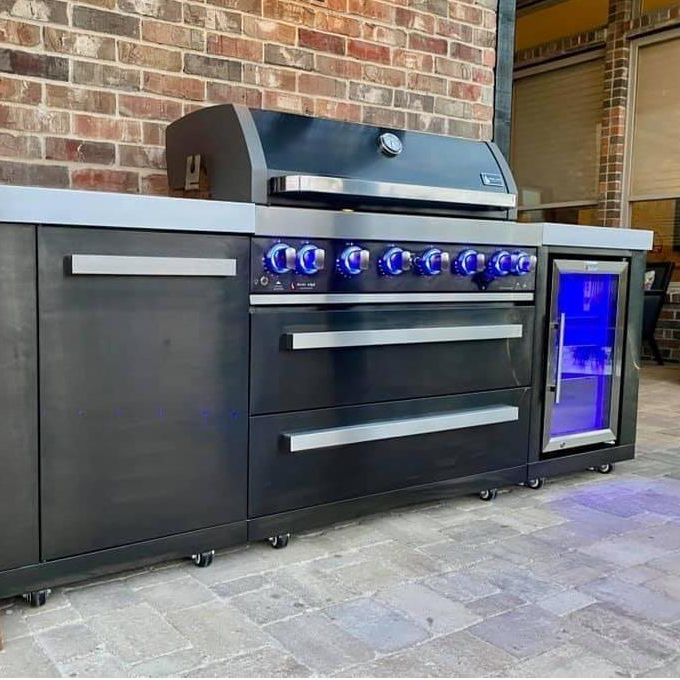
A strip of warm LED lighting along the base of your outdoor kitchen island creates a floating effect that looks polished at night and also doubles as soft path lighting around the structure.
Use a warm white 2700K strip behind a diffuser channel for a clean, finished look rather than a DIY result.

In warm climates, a wet-rated ceiling fan with a built-in light module serves double duty: it keeps air moving over cooking and dining areas while providing ambient overhead lighting.
Most modern outdoor fans have a dimmable light module with adjustable color temperatures. For sizing, use a 52-inch fan for covered areas up to 225 square feet.
Every outdoor fixture has ratings that tell you whether it can handle the weather and the job you are asking it to do.
Here is a quick reference for the most common outdoor kitchen lighting ideas and the specs that apply to each one.
| Fixture type | Min. IP rating | Best color temp | Typical wattage (LED) | Zone |
|---|---|---|---|---|
| Under-cabinet LED strips Most functional | IP65 | 3000K to 4000K | 5 to 15W per strip | Task |
| Recessed downlights (pergola/ceiling) | IP44 (wet-rated for open structures) | 2700K to 3000K | 8 to 15W per fixture | Ambient + Task |
| String lights (globe/Edison) | IP44 | 2200K to 2700K | 1 to 4W per bulb | Ambient |
| Pendant lights | IP44 (damp or wet rated) | 2700K to 3000K | 8 to 12W | Ambient + Task |
| Wall sconces / lanterns | IP44 | 2700K | 8 to 15W | Ambient |
| Landscape uplights | IP65 (in-ground: IP67) | 2700K to 3000K | 4 to 10W | Accent |
| Path and step lights | IP65 | 2700K to 3000K | 2 to 5W | Safety + Accent |
| Island base LED strip | IP65 | 2700K | 5 to 10W per strip | Accent |
| Ceiling fan with light | Wet-rated (UL listed) | 2700K to 3000K (tunable) | 15 to 30W (light module) | Ambient |
IP stands for Ingress Protection. The first number after IP rates dust resistance (0 to 6). The second rates water resistance (0 to 8). IP44 means the fixture is protected from objects larger than 1mm and from water splashing from any direction. IP65 means it is fully dust-tight and protected from water jets. For any fixture that could see direct rain, use IP65 or higher. For a covered pergola with no direct rain exposure, IP44 is usually enough.
A good lighting plan divides your outdoor kitchen into zones and assigns the right fixtures and circuit type to each one.
This gives you the control to adjust each area independently depending on whether you are cooking, eating, or just relaxing outside.
| Zone | What it covers | Recommended fixtures | Circuit type |
|---|---|---|---|
| Cooking zone | Grill, burners, prep counters | Under-cabinet LED strips, recessed downlights above counter | Separate circuit, no dimmer required |
| Bar or dining counter Key zone | Bar seating, serving surface | Pendant lights 30 to 36 inches above counter, under-counter LED strips | Dimmable circuit |
| Dining and seating area | Table, lounge, conversation zone | String lights overhead, wall sconces, ceiling fan with light | Dimmable circuit |
| Perimeter and landscape | Plants, trees, boundary | Landscape uplights, path lights, wall lanterns | Low-voltage landscape circuit or smart plug |
| Paths and steps | Entry paths, elevation changes | Path lights, recessed step lights | Low-voltage landscape circuit |
| Island base / decorative | Outdoor kitchen island exterior | LED strip in diffuser channel | Dimmable or smart control |
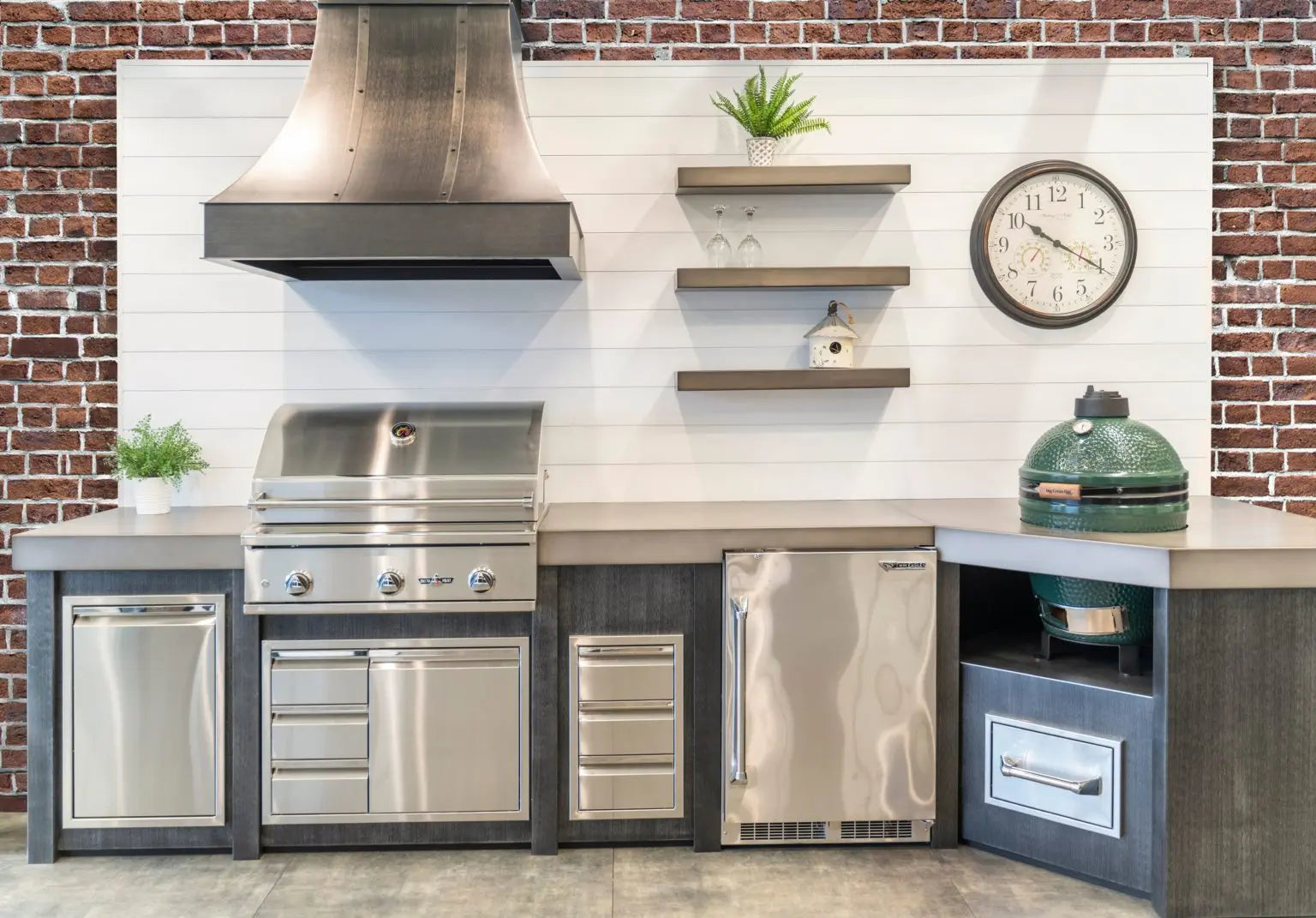
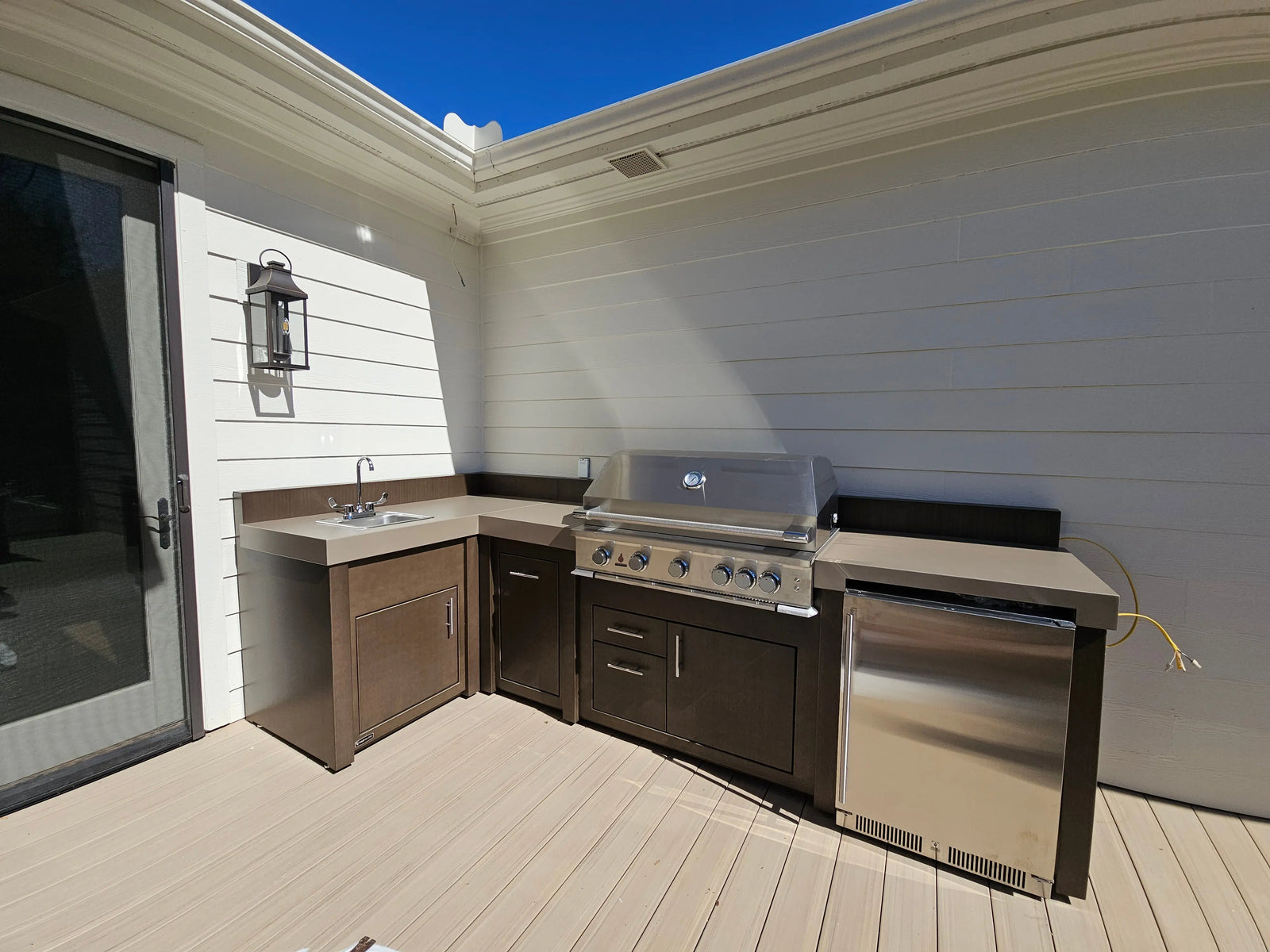
The right outdoor kitchen gives you the structure, the covered areas, and the distinct zones that make layered lighting possible. BetterPatio carries prefab, modular, and custom outdoor kitchens with free shipping and a price match guarantee.


The best outdoor kitchen lighting uses all three layers together: task, ambient, and accent. Task lighting (under-cabinet LED strips, recessed downlights) keeps cooking zones bright and shadow-free. Ambient lighting (string lights, pendant fixtures, wall sconces) creates the overall atmosphere for dining and gathering. Accent lighting (landscape uplights, path lights, island base strips) adds depth and visual interest. Using only one layer, which is the most common mistake homeowners make, results in a space that either feels overlit and flat or too dark and uninviting.
Aim for 2700K to 3000K (warm white) for ambient and accent lighting. This range creates a welcoming, warm atmosphere that flatters food, people, and outdoor materials like wood and stone. For task lighting over the grill and prep counters where visibility is the priority, you can go up to 3500K to 4000K without it feeling clinical. Avoid cool white or daylight (5000K and above) for any social or ambient zone because it creates an unflattering, harsh appearance that makes the space feel uncomfortable.
All outdoor kitchen fixtures need to be weather-rated. At minimum, look for an IP44 rating (protection from water splashing from any direction) for fixtures under a covered pergola or roof structure. For any fixture that could be exposed to direct rain, including uncovered kitchens or fixtures near the outer edges of a pergola, use IP65 or higher. For coastal environments with salt air and humidity, IP65 is the minimum across the board. Always confirm the UL listing: "UL Wet Location" for direct rain exposure and "UL Damp Location" for covered outdoor use.
Task zones like the grill and prep counters need 30 to 50 foot-candles of illumination, which works out to around 300 to 500 lumens per square foot of counter surface. For a standard 6-foot grill island counter, two 800-lumen recessed downlights or a 10-watt LED strip provide enough task lighting. Ambient zones need less: 10 to 20 foot-candles is comfortable for dining areas. A practical starting point is 80 to 100 lumens per square foot for task areas and 30 to 50 lumens per square foot for ambient zones. Adjust from there using dimmer controls.
Yes. The easiest retrofits are plug-in string lights (no wiring needed), outdoor LED strip lights on a smart plug, battery-powered path lights, and solar-powered landscape uplights. For hardwired fixtures under a pergola or recessed lights in a ceiling, you will need a licensed electrician to run conduit and wire from an outdoor outlet or breaker. This is more involved in an existing structure but is very common and usually takes one to two days. Adding a dedicated outdoor circuit with a weatherproof GFCI outlet gives you the most flexibility for future lighting additions.
Outdoor kitchen lighting ideas only get better when they are layered on purpose. Task lighting keeps you safe at the grill. Ambient lighting makes the whole space feel welcoming. Accent lighting makes everything look designed instead of just assembled.
Put all three on separate circuits with dimmers, use warm white LEDs rated for outdoor use, choose fixtures with the right IP rating for your coverage situation, and your outdoor kitchen will be just as good at 9pm as it is at noon.
If you are still planning your kitchen setup, BetterPatio's design team can help you get the kitchen and the lighting plan right from day one, at no charge.

As the outdoor living trend continues to thrive, you may be wonder...

How to transform your outdoor space in 5 steps to...