Before you buy a single appliance, knowing your space requirements can save you thousands of dollars and a summer of headaches.
Too small and you're crowded at the grill. Too large and your budget spirals. This guide covers the exact clearances, layout dimensions, and sizing rules you need to build a kitchen that actually works for your backyard.
Before you buy anything, the planning starts with three simple questions:
Take a tape measure outside and mark off the area. Note any obstacles (fences, posts, drainage grates, AC units).
Quick weeknight burgers for the family is one thing. Hosting 12 people every weekend is another.
Just a grill? Or grill plus side burner, sink, fridge, pizza oven, and bar seating?
Once you have those answers, you can match a layout to your space. The bigger the appliance list, the more room you need.
A bare-bones grill island fits in 5 to 6 feet. A full kitchen with bar seating needs 15 to 20 feet of patio or more.
For homeowners with smaller patios, the outdoor kitchen islands for small spaces collection shows what is possible in tight setups.

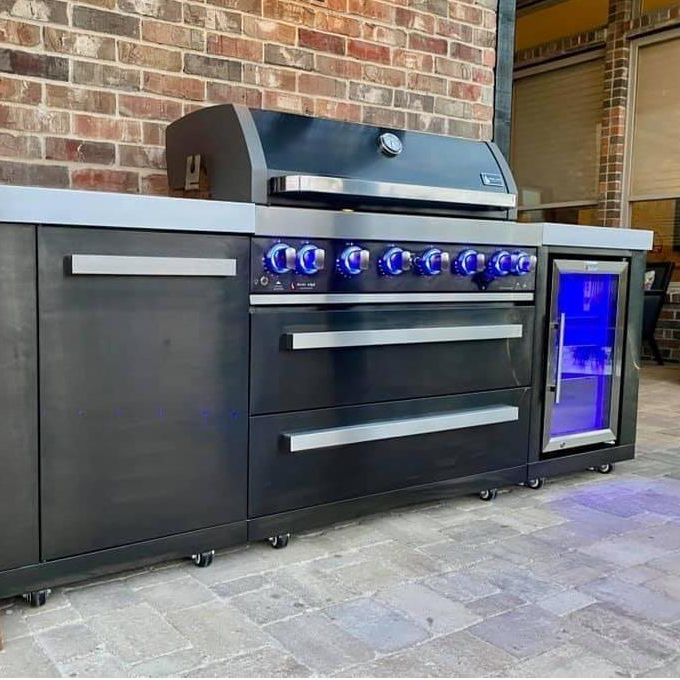
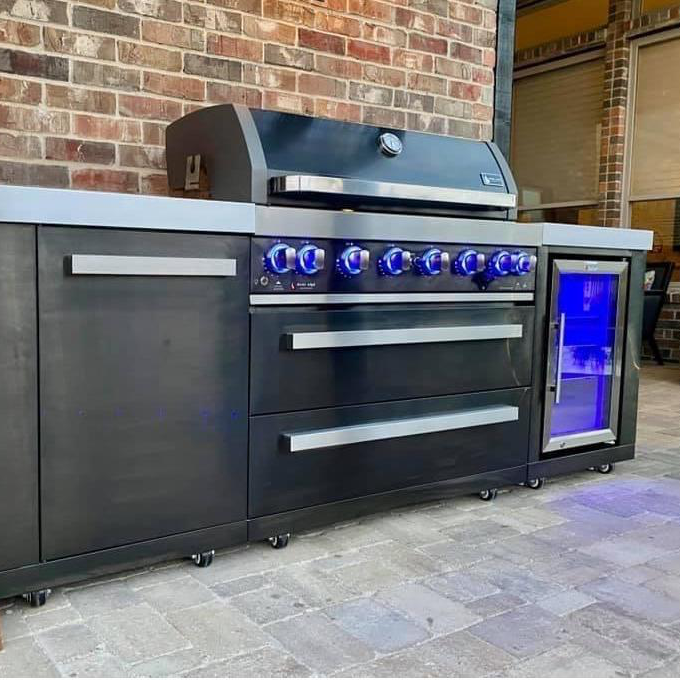
Best for small spaces. Minimum length is 6 linear feet, while the most functional setups range between 8 and 12 feet.
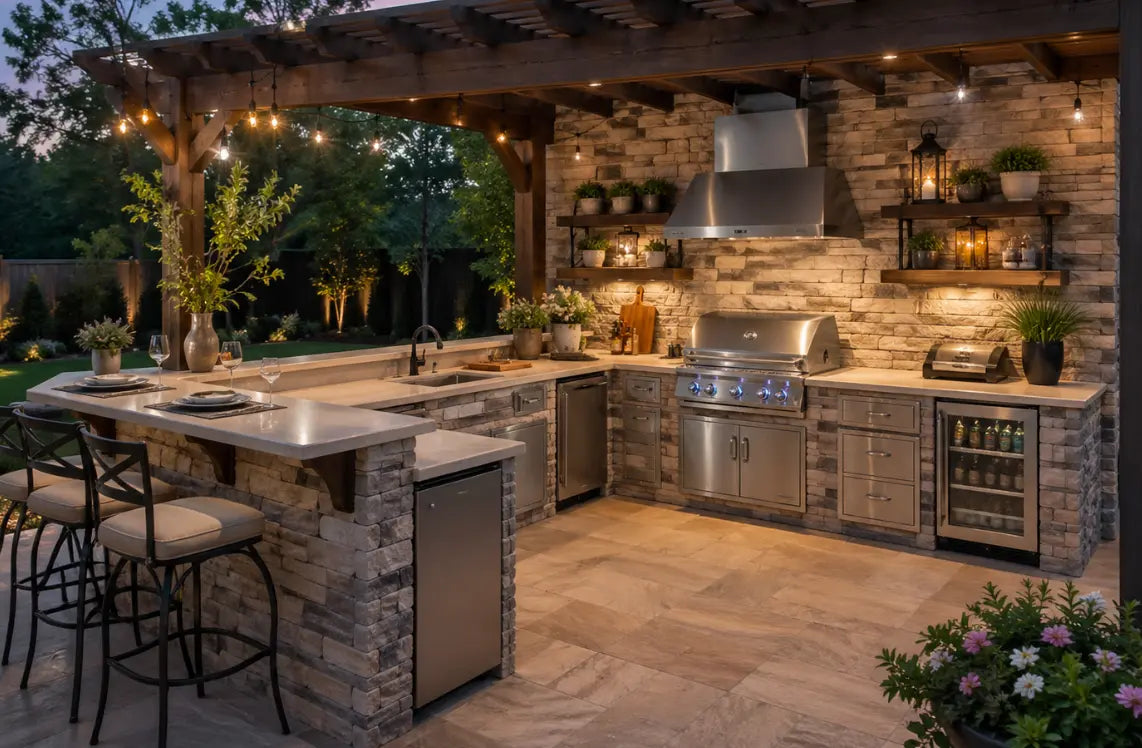
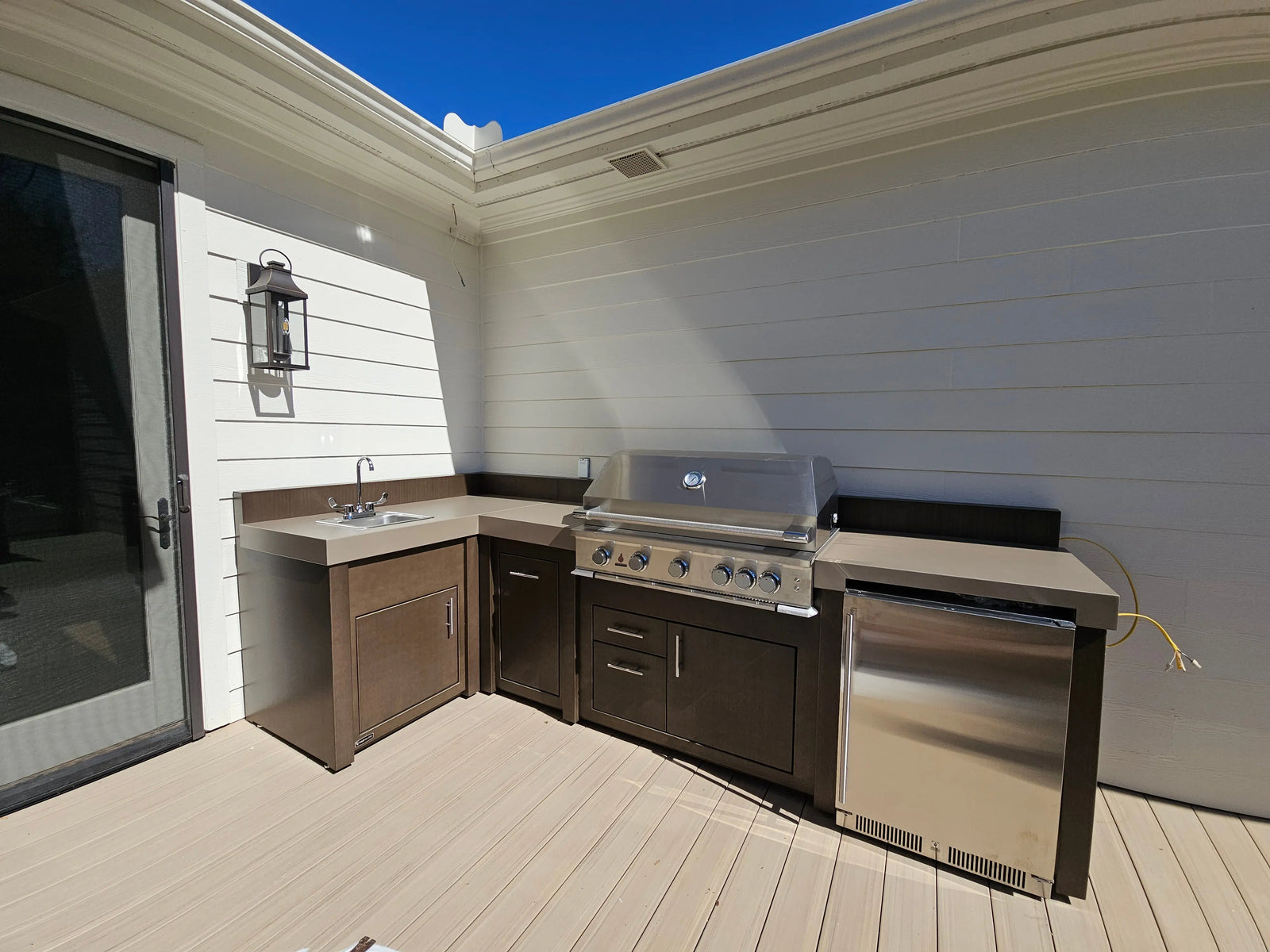
The most versatile choice. Two perpendicular runs provide a natural work triangle and fit corner spaces perfectly.
Designed for large hosting. Requires at least 60 inches of interior clear space so the cook doesn't feel trapped.
| Layout Type | Min. Island Size | Patio Space | Best Use Case |
|---|---|---|---|
| Linear (Straight) | 6 ft run | 10 ft x 8 ft | Compact patios |
| L-Shaped Top Pick | 10 ft + 5 ft | 16 ft x 12 ft | Medium patios & entertaining |
| U-Shaped | 20 ft total | 20 ft x 16 ft | Large backyard hosting |
| Freestanding Island | 4 ft x 2 ft | 13 ft x 10 ft | Social backyard cooking |
Our design team provides free 3D renderings within 48 hours to help you visualize these layouts in your specific space. Start your free design here.
Safety is the priority. You must maintain at least 36 inches around your grill, but we always recommend 42 inches.
This ensures that even when the grill lid is open and people are passing by, nobody is at risk of a burn.
Standard counter height is 36 inches to match your indoor kitchen. If you want bar seating, raise the guest-facing section to 42 inches.
For comfort, ensure bar-height stools have at least 15 inches of knee clearance.

Different layouts solve different space problems. Here are the five common ones.
Space needed: 6 to 12 feet of wall or open space, 4 feet of patio depth.
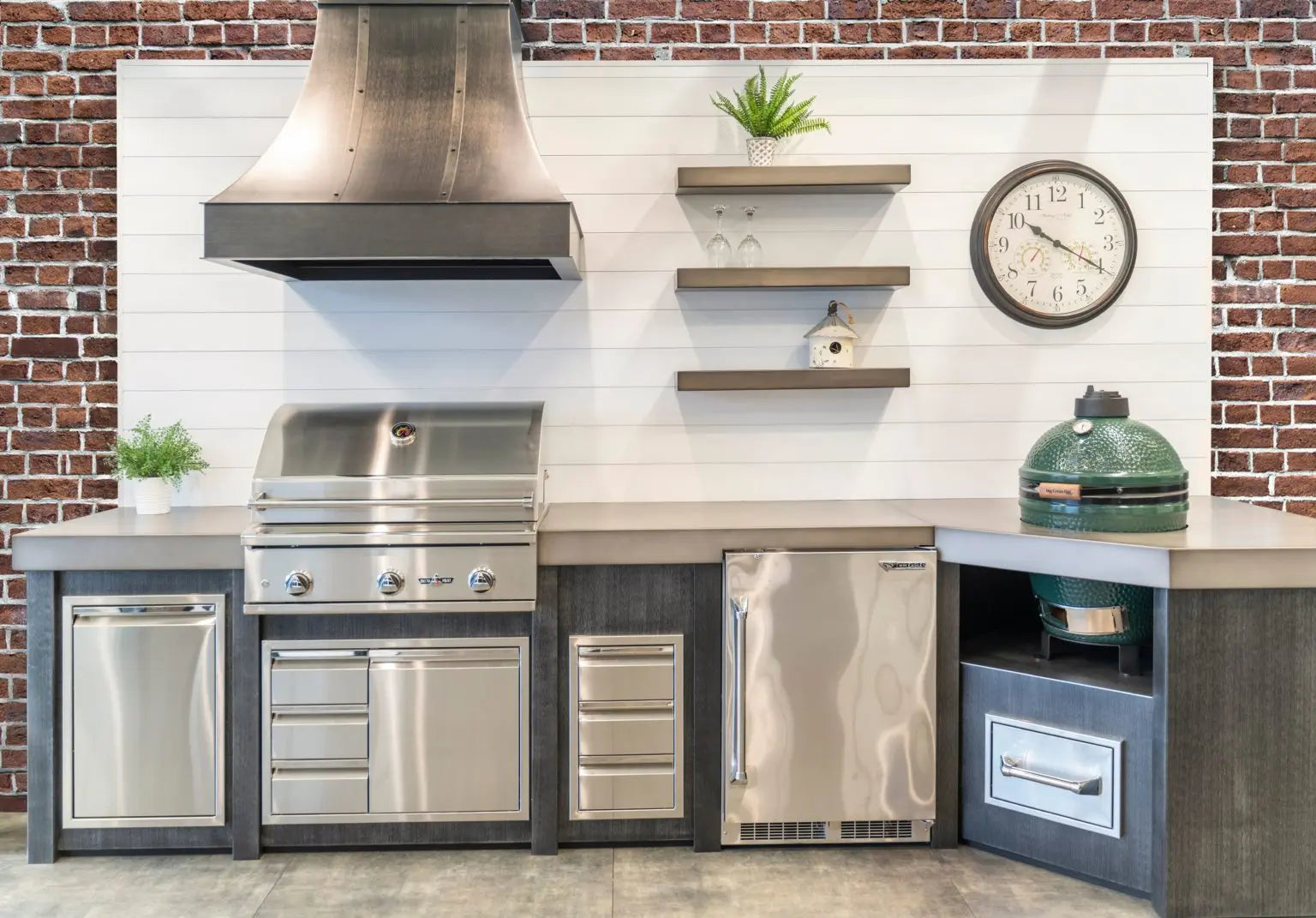
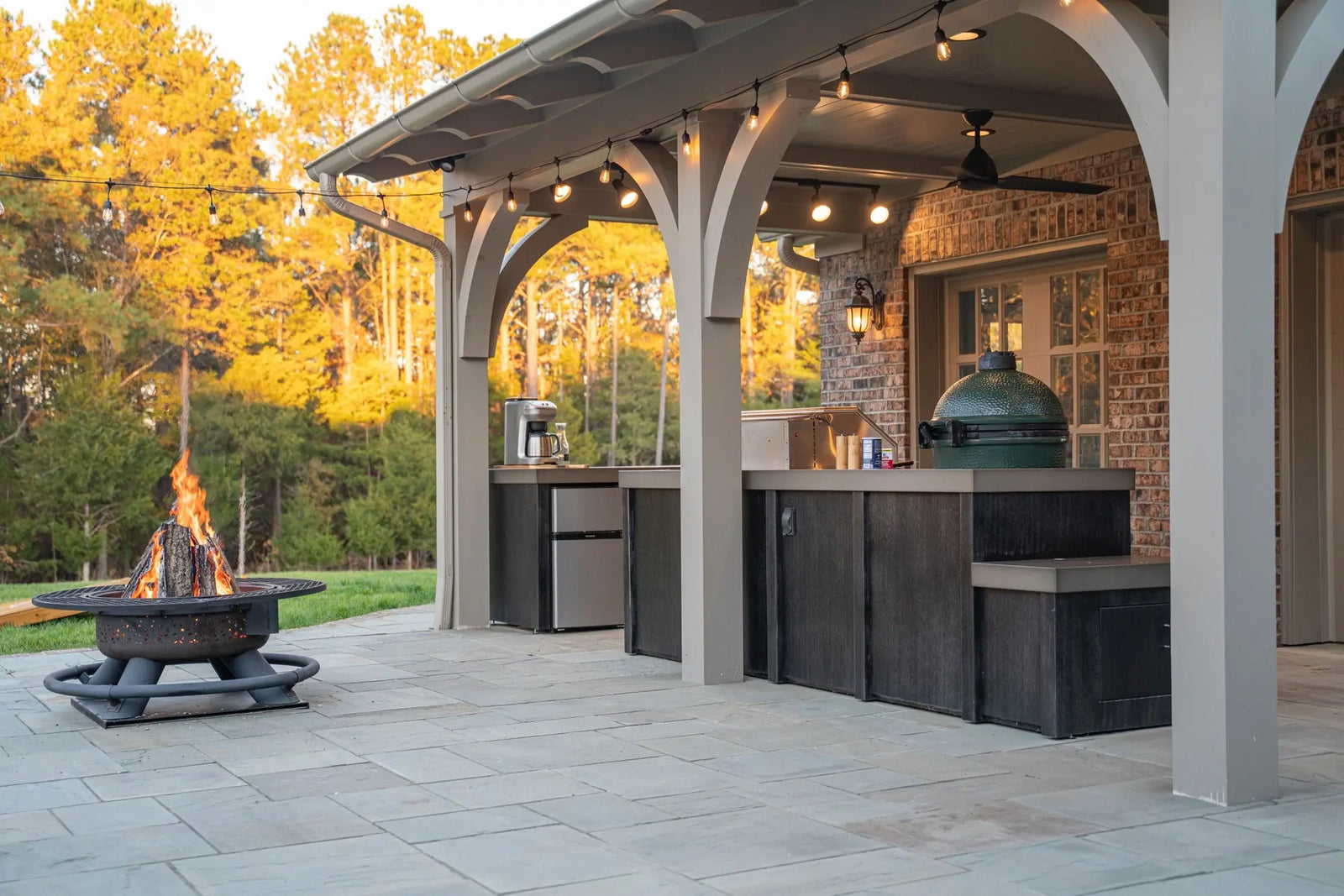
A linear kitchen runs along one straight line. Grill, counter, storage, and any side burner all sit in a row. This is the most space-efficient layout and works great against a fence, house wall, or open patio edge.
Pros ✅️: Smallest footprint. Easy to install. Affordable. Cons: The cook has their back to guests if it sits against a wall.
Space needed: Open space on all four sides, 6 to 12 feet long, 4 feet of clearance around all sides.
An island is a freestanding unit that opens on all four sides. Great when you want the cook to face guests and chat while grilling.
Pros ✅️: Includes the cook in the action. Flexible placement. Cons: Needs more open space than linear setups. Often costs more.
Space needed: Two walls or open sides, 8 feet long on each leg, plus walkway space.
The most popular layout for medium and large patios. The L-shape gives you separate zones for grilling and prep, plenty of counter space, and works perfectly in corners.
Pros ✅️: Maximum counter space. Natural work triangle. Fits corners. Cons: Needs more square footage than linear. Better in larger patios.
The L-shaped outdoor kitchen collection shows the most common configurations and how they fit different patio sizes.
Space needed: Three open sides or walls, 10+ feet on each leg.
A U-shape gives you the most counter space and feels like a full enclosed kitchen. Ideal for serious cooks who use multiple appliances at once.
Pros ✅️: Maximum counters and storage. Very efficient for one cook. Cons: Largest footprint of any layout. Can feel separated from guests if too big.
Space needed: Two parallel walls or counters with 4 to 5 feet between them.
Two long counters facing each other. Less common in outdoor kitchens but works well when you want separate cooking and serving zones.
Pros ✅️: Two cooks can work without bumping into each other. Cons: Needs careful spacing to avoid feeling cramped.
These are the standard numbers used by outdoor kitchen designers. Stick close to them, and your kitchen will feel comfortable.
| Element | Standard Size | Notes |
|---|---|---|
| Minimum kitchen length | 6 feet | Grill plus counter on each side |
| Counter depth | 24 inches | Standard, can go to 30 inches |
| Counter height (cooking) | 36 inches | Same as indoor kitchens |
| Counter height (dining) | 30 inches | More comfortable with regular chairs |
| Bar height | 42 to 48 inches | Match with bar stools |
| Bar overhang | 12 to 18 inches | Max one-third of total bar width |
| Workspace next to grill | 36 inches minimum | 24" one side, 18" other side |
| Workspace each side of sink | 18 inches | For prep and clean-up |
| Walkway behind cook | 36 to 50 inches | 50 inches if more than one cook |
| Bar seating per person | 20 to 24 inches | Width per stool |
| Behind-bar clearance | 26 to 42 inches | For pulling stools back and walking |
BetterPatio carries pre-assembled BBQ islands, L-shaped outdoor kitchens, modular setups, and fully custom builds. Each is available in multiple sizes so you can match the kitchen to the space, not the other way around.
Technically, 6 linear feet is the minimum for a functional island (grill + landing space). However, you need to account for a roughly 10x8ft zone on your patio to include safe walkways around the unit.
Always aim for 42 inches of clearance. While 36 inches is the bare minimum, 42 inches allows two people to move comfortably without crowding the cook.
Plan for 5 feet of open space behind bar stools. This allows guests to pull out their chairs and sit comfortably without blocking high-traffic walkways.
A built-in grill needs at least 36 inches of total counter workspace, broken down as 24 inches on one side and 18 inches on the other. This gives you somewhere to set raw meat, finished food, and grilling tools while cooking. Behind the grill, leave at least 36 inches of walkway so the cook can move freely.
An L-shaped outdoor kitchen needs a minimum patio area of about 15 by 15 feet to feel comfortable. The L itself usually has 8-foot legs, which gives you separate grilling and prep zones plus optional bar seating along one leg.
Don't let the excitement of a new grill lead to a cramped patio. Measure your space, consider your movement patterns, and prioritize layout over appliance count.
If you need help, our team is ready to provide a custom 3D plan to ensure your backyard transformation is perfect.

As the outdoor living trend continues to thrive, you may be wonder...

How to transform your outdoor space in 5 steps to...