Building an outdoor kitchen frame is the most important structural decision you'll make before breaking ground. Get it right and you've got a solid base for countertops, appliances, and cladding that holds up for decades. Get it wrong and you're looking at cracks, rust, or a rebuild within a few years.
The two most common framing options are steel stud and concrete block. Each has its own strengths depending on your climate, budget, and how complex your layout is. This guide breaks down both methods so you can choose the right frame and build it with confidence.
Browse our full collection of outdoor kitchens to find the right setup for your yard.

Your frame choice decides how long your outdoor kitchen will last and what headaches you might face later. The material, your local rules, and your property's quirks all play a part in what'll work best.
The frame is the backbone of your outdoor kitchen. It holds up your countertop, supports your grill and appliances, and gives shape to the whole thing. If you skimp here, you'll end up with cracked finishes, sagging counters, or wobbly appliances.
Your frame also affects how much storage you get. Metal stud frames are hollow, so you can stash propane tanks or drawers inside. Block frames are solid, so there's not much room for storage.
And your choice limits your finish options. Metal stud frames pair best with lightweight stone veneer or tile. Block frames can handle heavy natural stone or thick veneer, no problem.
Climate and location matter a lot. Freeze-thaw cycles can wreck cement board sheathing on metal frames since moisture sneaks in and expands when frozen. Salt air in coastal areas will corrode both galvanized steel and aluminum over time. High humidity — anything above 60% — speeds up corrosion in metal parts.
Your surface makes a difference, too. If you're building on a deck or patio, you'll want a lighter frame like metal studs. Block frames need a poured concrete slab or footing for support. You can't put concrete blocks on a wooden deck.
Budget and skill level come into play. Metal stud frames are cheaper upfront but take more finishing steps. Block construction needs heavier lifting, mortar mixing, and a bit of masonry know-how. Metal frame kits are DIY-friendly with just basic tools.
Most places require permits for outdoor kitchens. Local building codes set rules for gas lines, electrical, and how things need to be built. Sometimes you need specific clearances between flames and anything flammable.
Make sure your property drains well before you start. Water pooling around your frame will rust metal or break down mortar joints in block construction. The concrete slab should slope away from the kitchen, even just a little.
Codes often spell out foundation requirements based on your frame and local conditions. Frost footings might be needed in cold climates, or special attachment methods in windy spots. Always check with your building department before buying materials — you don't want expensive surprises.

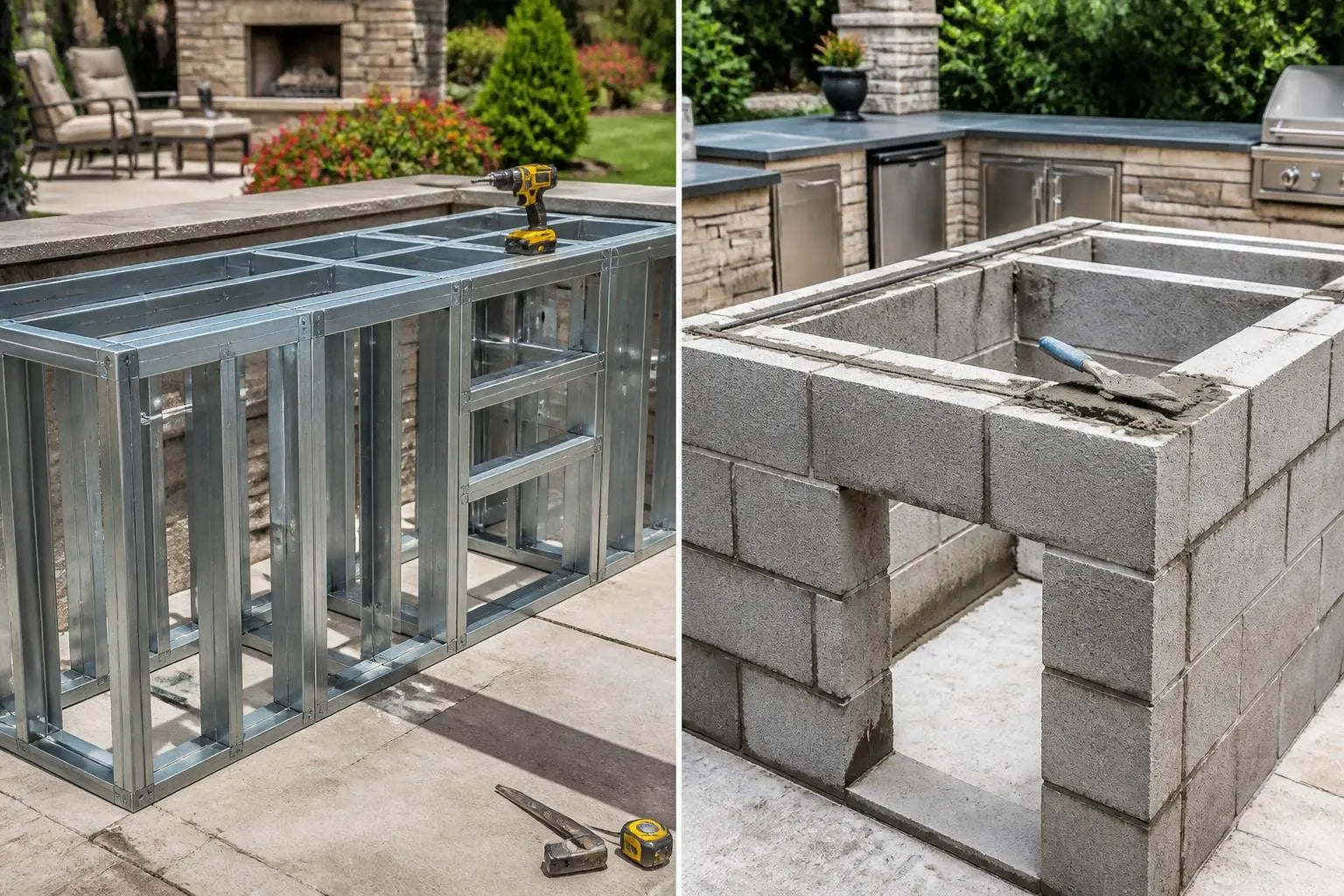
Steel stud framing uses galvanized metal studs and tracks to create a lightweight, durable skeleton for your outdoor kitchen. It shrugs off rot and pests, and you get a lot of flexibility for the price.
You start by anchoring galvanized steel studs between U-shaped metal tracks — the top and bottom plates. Usually, you space the studs 16 or 24 inches apart.
First, you fasten the bottom track to the concrete with anchors or screws. Then you cut your vertical studs to size and pop them into the bottom track. Self-tapping screws hold each stud in place — they drill their own holes as you drive them in.
After you've got all the vertical studs in, you add the top track and screw it down. For appliances, you frame out openings with extra horizontal and vertical studs. You'll also need horizontal blocking where the countertop will sit.
Finish by screwing on cement board or another exterior-rated sheathing. Use corrosion-resistant screws — they're made for metal studs and outdoor use.
Steel stud framing is great when you want a quick, affordable outdoor kitchen and don't want to wrestle with heavy masonry. If you're handy with power tools but not a pro mason, this method fits.
Metal studs work best if you're using lighter finishes like stucco, tile, or thin stone veneer. They're also a good pick for covered kitchens or spots where you want to keep the weight down — like on a deck. And if you ever want to move or change things later, you can take apart and rework a steel stud frame pretty easily.
I'd skip steel studs in areas with constant moisture or if you're planning to use heavy natural stone cladding that'll push the frame's weight limits.

Concrete block construction uses stacked masonry blocks to build a sturdy base. It's naturally fireproof and can handle serious weight, which makes it a go-to for permanent outdoor kitchens.
You start with a flat, level concrete slab or footer. Pour and let it cure for a few days before stacking blocks.
With the foundation set, you lay out and stack standard 8x8x16-inch concrete blocks, which have hollow cores. You can fill these with rebar and concrete for extra strength.
Mortar goes between each block. Keep the blocks level as you build each row. The mortar needs time to cure for full strength.
The blocks make up the outer shell and main support. Leave gaps for appliance doors or utilities as you go. Once you hit counter height, top the walls with a bond beam or concrete cap before installing the countertop.
Go with concrete blocks if you're building a big, permanent outdoor kitchen with heavy countertops. Natural stone or thick concrete counters really need this kind of solid support.
This method shines in warm climates where freeze-thaw isn't a problem. It's also great if you want fire resistance right next to your grill.
If you care more about budget than speed, blocks are a solid choice. The materials are cheaper, but you'll spend more time building. If you're not in a rush and don't mind some DIY elbow grease, you'll save money here.
Blocks are ideal if you're building on a level concrete pad that's already there. That slab gives you a ready-made foundation for stacking blocks right away.
Steel studs are cheaper and quicker, but concrete blocks hold up better in nasty weather. It really depends on your budget, climate, and how much weight you need to support.
Concrete blocks tend to last longer in most climates. They shrug off moisture and won't rust. Blocks also manage freeze-thaw cycles and extreme temps better than steel.
Steel studs can rust, especially near the coast. Even galvanized steel will eventually corrode if it's always damp. You've got to use protective coatings and make sure water drains away from the frame.
Heat transfer is another thing to think about. Steel gets hot fast, so the frame can heat up near your grill. Concrete blocks insulate better, so the outside stays cooler when you're cooking.
| Factor | Steel Stud | Concrete Block |
|---|---|---|
| Material cost | $300 – $600 | $500 – $900 |
| Labor time | 1 weekend (DIY) | 3-5 extra days |
| Foundation needs |
| Scenario | Recommended Frame |
|---|---|
| Tight space or deck | Steel studs |
| Heavy stone countertops | Concrete block |
| Coastal / high humidity | Concrete block |
| Quick DIY project | Steel studs |
| Long-term permanent build | Concrete block |
| Custom odd-shaped layout | Steel studs |
Steel frames are more flexible for custom layouts. You can move studs around for odd shapes or unique appliance setups. Blocks are easier if you're sticking to rectangles or L-shapes with standard sizes.
Steel stud and concrete block frames each have their own process and tools. Steel studs need careful measuring and fastening, while blocks require some patience with mortar and leveling. Neither is rocket science, but each has its quirks.
For Steel Stud Frames:
For Concrete Block Frames:
You'll need cement board for both methods to create a surface for tile or other finishes.
Use a chop saw fitted with a metal blade. Full protective gear is a must — cutting steel throws sparks, and those edges can be nasty. Double-check your measurements before you cut.
Drive 1/2-inch self-tapping stainless screws through the metal with your screw gun. Use locking pliers with flat jaws to steady the layers while you work.
Space them 16 inches apart for most builds, or closer if you plan on mounting heavy appliances. The frame feels light and you can move it around before you anchor it for good.
Run electrical conduit through the frame before you attach the cement board. Measure for appliance cutouts — be precise here. Mark those spots on your frame so everything fits later.
Use one-inch self-tapping screws. Cut the board with a circular saw and fiber cement blade, or just score and snap it with a utility knife. Add horizontal blocking between studs under the countertop for extra support.
Use a string line to keep your perimeter straight. Mix Type S mortar until it feels like peanut butter — thick but workable.
Spread a one-inch mortar bed along your layout line. Place each block into the mortar, checking for level both ways. A rubber mallet helps nudge blocks into place.
Apply mortar to the top of the previous course and the ends of each new block. Stagger your joints so the seams don't stack up. Keep checking for level and use your string line to stay straight.
Drop rebar vertically through block cells for strength. Leave openings in the blockwork for appliances, sized to your equipment.
Fill the block cells with rebar using mortar or concrete for extra strength. Let everything cure for 48-72 hours before moving on to countertops and appliances.
Shop our patio furniture to find pieces that fit your layout and style.

As the outdoor living trend continues to thrive, you may be wonder...

How to transform your outdoor space in 5 steps to...