Concrete vs. Granite vs. Quartzite Outdoor Countertops

Concrete vs. Granite vs. Quartzite Outdoor Countertops
Expert Comparison

Picking the right material for your outdoor kitchen is a bigger decision than most homeowners realize. Sun, rain, heat, and daily wear handle each material differently.

Get the choice right and your countertop looks great for $20+$ years. Get it wrong and you face fading, cracking, staining, or expensive replacement way sooner than expected.

Key Takeaways
  • Concrete is highly customizable but prone to hairline cracks and requires regular sealing.
  • Granite is the most popular pick with excellent heat resistance and over 2,500 color options.
  • Quartzite is the toughest of the three, offering marble-like aesthetics with superior UV resistance.
  • Cost ranges: Granite $40 to $100 per square foot, concrete $65 to $135, quartzite $80 to $200+.
  • Avoid Quartz: Engineered quartz fades and warps outdoors. Quartzite is the natural stone you want.

What Each Material Actually Is

Before comparing performance, here is what each material actually is, because the names confuse a lot of people.

Concrete

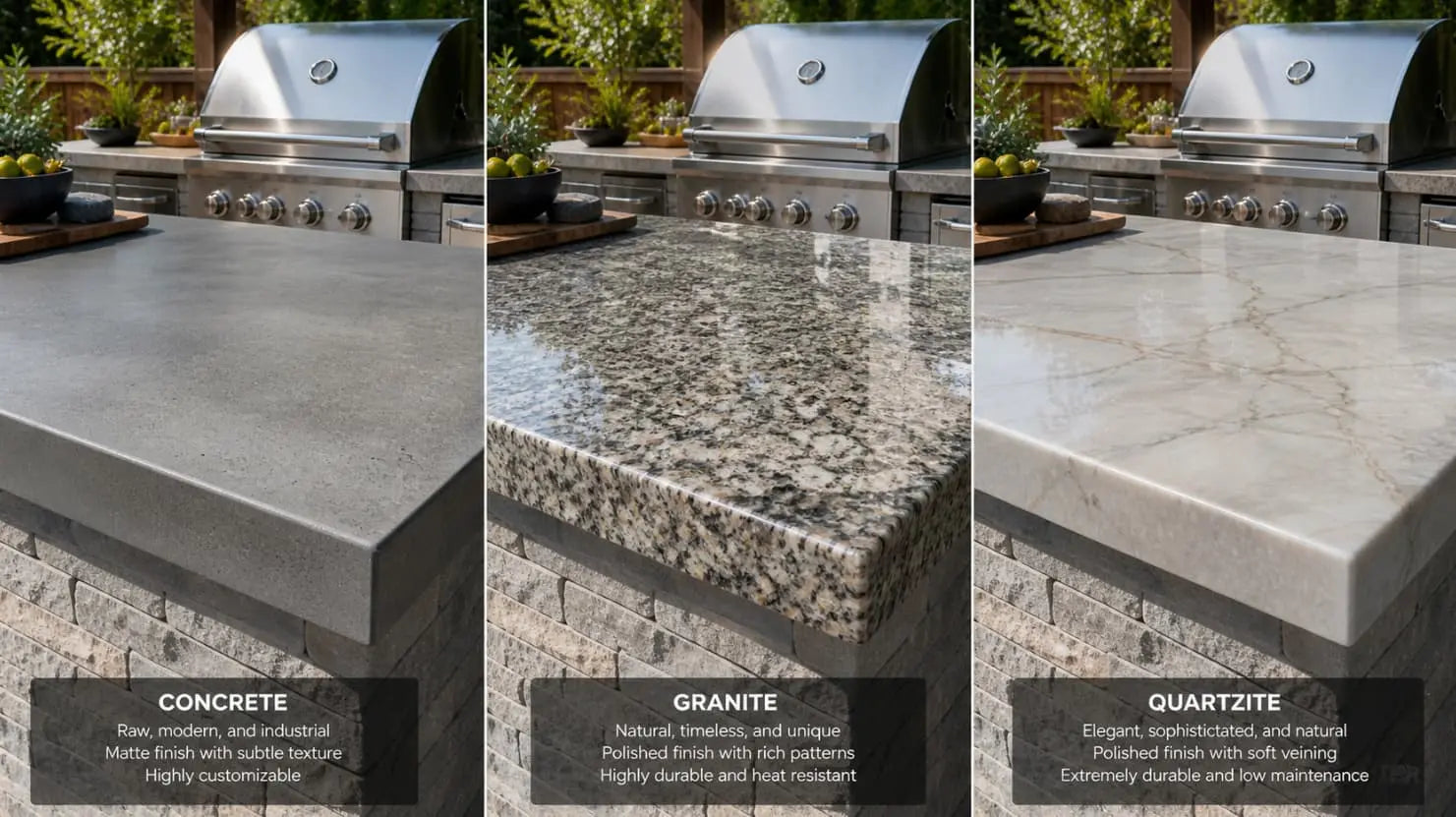
A man-made material poured in molds from cement, sand, aggregate, water, and pigments. Outdoor concrete countertops are usually 1.5 to 2 inches thick and reinforced with rebar or fiber. Color, texture, edges, and inserts (like glass or shells) can all be customized.

Granite

A natural igneous rock formed deep underground when magma cools and crystallizes. Granite is dense, hard, and one of the most heat-resistant countertop materials on earth. Each slab is unique because the mineral patterns formed over millions of years.

Quartzite

A natural metamorphic rock that started as quartz sandstone and got transformed by heat and pressure deep underground. Quartzite is harder than granite (Mohs 7 vs Mohs 6 to 7) and often looks like marble, with soft white-to-gray veining.

⚠️
Important: Quartzite vs Quartz Quartzite is 100% natural rock. Quartz is engineered with resins that break down under UV light. Never use standard indoor quartz for an outdoor kitchen.

Concrete vs. Granite vs. Quartzite: Outdoor Performance

Concrete vs. Granite vs. Quartzite: Outdoor Performance Compared
🔥
Heat Resistance

Granite and Quartzite are excellent; hot pots straight off the grill are no problem. Concrete is good, but the sealer can scorch or discolor at high temperatures. Use trivets.

☀️
UV Resistance

Quartzite wins here (best in class). Granite is excellent; natural color is locked in. Concrete is good for the slab, but pigments and sealers can fade slowly under direct sun.

🍷
Stain Resistance

Granite is good (dark colors are near stain-proof). Quartzite is good when sealed. Concrete is porous and stains easily without heavy maintenance.

🔨
Durability and Cracking

Granite: Very durable. Rare to crack. Edges can chip from heavy impact.
Quartzite: Most durable of the three. Hardest natural stone in regular kitchen use.
Concrete: Hairline cracks are normal and common over time. Most are cosmetic, but they appear in nearly every concrete countertop within $5$ years.

🧼
Maintenance

Granite: Reseal every $12$ to $18$ months. Wipe with mild soap and water.
Quartzite: Reseal once a year. Same easy cleaning.
Concrete: Reseal yearly, plus monthly waxing for some finishes. The most maintenance of the three.

Side-by-Side Comparison

Feature Concrete Granite Quartzite
Material type Man-made Natural igneous rock Natural metamorphic rock
Cost per sq ft (installed) $65 to $135 $40 to $100 $80 to $200+
Heat resistance Good (sealer at risk) Excellent Excellent
UV resistance Good (sealer fades) Excellent Best
Stain resistance Poor without sealer Good when sealed Good when sealed
Scratch resistance Medium Excellent Best (hardest)
Cracking risk High (hairline cracks normal) Very low Very low
Sealing frequency Yearly + monthly wax Every 12 to 18 months Yearly
Color options Limitless (custom) 2,500+ natural colors Mostly white/gray/cream
Look Modern, industrial Granular, varied Marble-like veining
Weight per sq ft 18 to 25 lbs 15 to 20 lbs 18 to 22 lbs
Lifespan outdoors 15 to 25 years 25+ years 30+ years
DIY friendly Possible (hard) No No

Concrete Outdoor Countertops: Pros and Cons

Concrete Outdoor Countertops

Pros

  • Limitless customization. Any color, shape, edge, or texture you can imagine.
  • Modern, industrial look that fits contemporary patio designs.
  • Can be poured seamlessly for large surfaces (no visible seams).
  • Patinas with age. Some homeowners love the lived-in look.
  • Inserts (recycled glass, shells, stones) make every counter unique.

Cons

  • Hairline cracks are normal, especially as the slab cures and ages.
  • Heaviest of the three, sometimes requiring reinforced cabinets.
  • Highest maintenance: yearly sealing plus monthly waxing for many finishes.
  • Sealer can scorch from hot pans, leaving discoloration.
  • Stains easily without proper sealing.
  • Long cure time (5 to 7 days minimum) before you can use it.
  • More expensive than basic granite for similar size.

Who is Concrete right for?

If you want a one-of-a-kind countertop, love the modern industrial look, and do not mind regular maintenance, concrete is your material. It is also the right choice if you want unusual colors or shapes that natural stone cannot match.

Granite Outdoor Countertops: Pros and Cons

Granite Outdoor Countertops

Pros

  • Excellent heat resistance. Hot pans straight off the grill.
  • 2,500+ color options, from black to red to blue.
  • One of the most affordable premium materials.
  • Lasts 25+ years outdoors when sealed.
  • Each slab is unique, with natural patterns and movement.
  • Easy to clean: soap and water.
  • Resists UV and weathering with no special treatment.

Cons

  • Needs sealing every 12 to 18 months.
  • Lighter colors can show stains more, especially from oil or wine.
  • Can have small fissures (cosmetic, not structural).
  • Edges can chip from heavy impact.
  • May need multiple slabs for large kitchens, leaving visible seams.

Who is Granite right for?

For most homeowners building an outdoor kitchen, granite is the safest, smartest choice. It nails every category that matters outdoors: heat, UV, durability, low maintenance, and reasonable cost. The wide color range means you can match almost any design style.

💡
BetterPatio Insight This is why most prefab and modular outdoor kitchens, including the BetterPatio Mountain Series and the prefab BBQ islands collection, come standard with 2-inch granite slab countertops.

Quartzite Outdoor Countertops: Pros and Cons

Quartzite Outdoor Countertops

Pros

  • Best UV resistance of all three. Zero fading even in full-sun patios.
  • Hardest natural stone, harder than granite.
  • Excellent heat resistance.
  • Marble-like veining with the toughness of granite.
  • Lasts 30+ years outdoors with proper care.
  • Naturally cool to the touch (great in hot climates).

Cons

  • Most expensive of the three. Premium material with premium pricing.
  • Limited color range. Mostly whites, grays, creams, with subtle veining.
  • Needs sealing once a year.
  • Acidic spills (wine, citrus, vinegar) can etch if left too long.
  • Sealer can crack from extreme heat, exposing the stone underneath.
  • Heavier than granite, sometimes requiring reinforced cabinet structures.

Who is Quartzite right for?

If you want the look of marble without the constant care, you have a sunny patio in a hot climate, and you do not mind paying more for the toughest natural stone available, quartzite is the right pick. It is also the smart choice for homeowners who plan to live in their home for 20+ years and want a countertop that outlasts everything else outside.


Cost Breakdown by Project Size

Kitchen Size Concrete Granite Quartzite
Small (15 sq ft, 6 ft kitchen) $975 to $2,025 $600 to $1,500 $1,200 to $3,000
Medium (25 sq ft, 10 ft kitchen) $\1,625 to $3,375 $1,000 to $2,500 $2,000 to $5,000
Large L-shaped (40 sq ft) $2,600 to $5,400 $1,600 to $4,000 $3,200 to $8,000
Premium U-shaped (60+ sq ft) $3,900 to $8,100+ $2,400 to $6,000+ $4,800 to $12,000+

Hidden costs to remember

  • Sealer reapplication: $50 to $150 per application, every year for all three.
  • Replacement when damaged: Full slab replacement runs the original installation price.
  • Cabinet reinforcement: For heavy stone (especially quartzite or thick concrete): $200 to $800.
  • Edge details: Add $15 to 30 percent for fancy edges like bullnose, ogee, or mitered.

For a full breakdown of overall outdoor kitchen pricing, the BBQ Island Headquarters page covers expected costs for prefab, modular, and custom builds.

Climate and Use Case Recommendations

Hot, sunny climates (Arizona, Texas, Florida, Southern California)

  • Best pick: Quartzite. Best UV resistance, no fading, naturally cool surface helps keep the kitchen comfortable in summer.
  • Second choice: Granite. Holds up to UV well and costs less.
  • Avoid: Engineered quartz, dyed concrete, lighter pigmented concrete (sealer fades fast under intense sun).

Cold-winter climates (Northeast, Midwest, Mountain West)

  • Best pick: Granite. Handles freeze-thaw cycles best.
  • Second choice: Quartzite. Also good with freeze-thaw, just more expensive.
  • Avoid: Concrete in extreme cold zones unless installed with proper expansion joints. Hairline cracks worsen with freeze-thaw.

Heavy entertaining and cooking

  • Best pick: Granite. Hot pots straight off the grill, soap-and-water cleanup, holds up to abuse.
  • Second choice: Quartzite. Slightly tougher but pricier.
  • Avoid: Concrete for serious cooks. The sealer scorches from hot pans and stains from spills.

Modern, contemporary, or industrial design styles

  • Best pick: Concrete. Custom shapes, integrated drainage, seamless pours, and the industrial look concrete is known for.
  • Second choice: Quartzite (specifically gray or white quartzite). Marble-like elegance fits modern design.
  • Avoid: Heavily patterned granite that fights with minimalist design.

Traditional or natural design styles

  • Best pick: Granite. 2,500+ colors, natural patterns, fits any traditional patio.
  • Second choice: Quartzite. Veining gives a high-end traditional look.
  • Avoid: Concrete in traditional designs unless you specifically want the modern contrast.
💡
Expert Tip For more on how to think about outdoor kitchen design overall, the Outdoor Kitchen 101 hub on BetterPatio covers material, layout, and feature decisions.

Installation: What to Expect

Concrete

  • Custom poured on-site or precast offsite, then transported.
  • Cure time: 5 to 7 days minimum, sometimes longer.
  • DIY is technically possible but very difficult to get right.
  • Heaviest option. Cabinet reinforcement often needed.

Granite

  • Slabs cut to size from larger source slabs.
  • Installation: 1 to 2 days for a typical kitchen.
  • Pros only. Slabs are too heavy and fragile for DIY.
  • Most prefab outdoor kitchens come with granite already installed.

Quartzite

  • Same process as granite, with diamond cutters required.
  • Installation takes longer because the stone is harder to cut.
  • Pros only. Quartzite cracks during installation if mishandled.
  • Add 10 to 20 percent to installation cost compared to granite.
🏠
Planning Tip For a deeper look at how prefab kitchens compare to custom builds, the Quick Assembly Outdoor Kitchens guide explains the different installation paths.

You May Want to Shop Outdoor Essentials

Ready to upgrade your patio? Here are our top-rated outdoor kitchen selections designed for long-term durability and maximum resale value.
Frequently Asked Questions

What is the best countertop material for an outdoor kitchen?

The best countertop material for most outdoor kitchens is granite. It handles heat, UV, weather, and daily wear better than nearly any other material at a reasonable cost. Granite comes in $2,500+$ colors and natural patterns, lasts $25+$ years outdoors with annual sealing, and works in both hot and cold climates. Quartzite is the upgrade option if you want the toughest natural stone with a marble-like look and have the budget for it. Concrete is the right pick only if you want a fully custom, modern look and do not mind the higher maintenance.

Is concrete or granite better for outdoor countertops?

Granite is generally better than concrete for outdoor countertops because it costs less, requires less maintenance, resists stains better, and almost never cracks. Concrete is heavier, develops hairline cracks over time, needs yearly sealing plus monthly waxing for many finishes, and stains more easily. Concrete wins only on customization. If you want a truly one-of-a-kind look with custom colors, shapes, edges, or embedded inserts, concrete delivers what no natural stone can. For everyday outdoor use, granite is the smarter long-term pick.

Is quartzite good for outdoor kitchens?

Yes, quartzite is one of the best natural stones for outdoor kitchens. It has the best UV resistance of any common countertop material because it is $100\%$ natural with no resins to break down in sunlight. Quartzite is also harder than granite, more heat resistant, and lasts $30+$ years outdoors when properly sealed. The trade-offs are higher cost (typically $\$80$ to $\$200+$ per square foot installed) and a more limited color range, mostly whites, grays, and creams with marble-like veining. For sunny patios where UV exposure is high, quartzite is the top performer.

What is the difference between quartz and quartzite?

Quartzite is a $100\%$ natural metamorphic rock formed when sandstone gets transformed by heat and pressure underground. Quartz is engineered, made from about $90\%$ crushed natural quartz combined with resins and pigments to create a uniform appearance. The biggest difference for outdoor use is UV resistance. Quartzite holds its color and integrity in direct sunlight indefinitely. Engineered quartz contains resins that yellow, fade, or warp under UV exposure, which is why quartz is not recommended for outdoor kitchens unless it is a specific outdoor-rated line. Quartzite is also harder and more heat resistant than quartz.

Do outdoor countertops need to be sealed?

Yes, all outdoor countertops need to be sealed to perform their best. Granite needs resealing every $12$ to $18$ months. Quartzite needs resealing once a year. Concrete needs yearly sealing plus monthly waxing for many finishes. Sealing protects against stains, water absorption, freeze-thaw damage, and UV breakdown of the stone surface. Without sealing, even granite and quartzite will absorb spills like wine, oil, or citrus juice, leading to permanent staining. Sealing is a $30$-minute DIY job for granite and quartzite (apply, wait, wipe). Concrete sealing is more involved.
Wrapping up
Granite is the smart all-around pick for 2026. Quartzite is the premium upgrade for high-sun climates. Save concrete for projects where a unique custom look is the primary design goal. Whatever you pick, seal it on schedule to protect your investment.

Keep reading